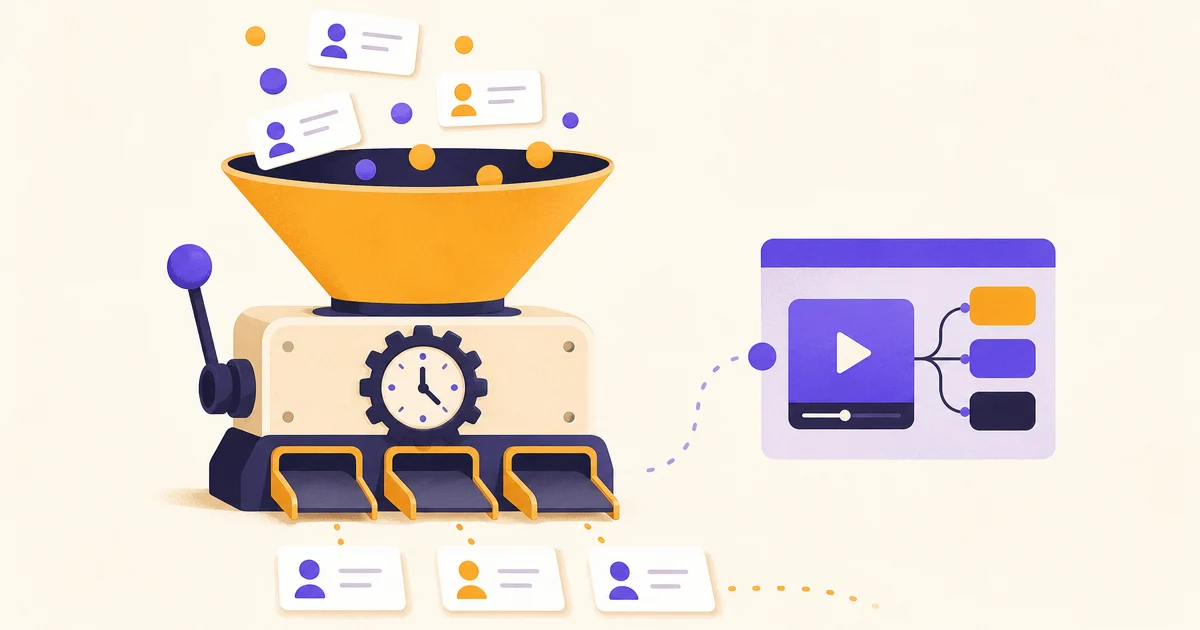
An automated sales funnel is a multi step buying journey, capture, scoring, sequence, follow up, that moves a visitor toward a purchase through rules written in advance, instead of a salesperson tracking each lead by hand. It replaces one to one follow up with a system that runs on its own, around the clock, across hundreds of leads at once.
What an Automated Sales Funnel Actually Is
The word funnel is younger than most marketers assume. William Townsend drew it for the first time in 1924, in a sales book called Bond Salesmanship. The model behind that drawing is older. Elias St. Elmo Lewis laid it out in 1898: an advertisement should first catch attention, then hold interest, then convince. He added a fourth step, action, later on. The acronym AIDA that gets attached to his name today actually comes from someone else, copywriter C.P. Russell, who coined it in 1921. A century later, the mechanics still hold. What changed is who runs them.
An automated sales funnel is that same journey running without a salesperson tracking each prospect one by one. Software captures the visitor, tags them based on what they clicked or downloaded, sends a pre built sequence in a fixed order, then follows up with anyone who hasn't acted yet. None of it requires opening a conversation. The system runs. Around the clock, across however many leads the traffic brings in.
It isn't a single sales page, or three emails thrown together in an email tool. And despite what most funnel software landing pages promise, it doesn't guess what each visitor wants either. An automated sales funnel executes rules written in advance: if someone clicked here, send that, if they haven't opened anything in five days, follow up with this. Those rules can get detailed. They never change what the message actually says inside a given branch.
How It Works, Step by Step
It starts with one narrow promise, traded for an email address. A guide, a recorded training, a free audit, or a quiz that hands back a personalized result in exchange for a few answers: the page that captures the visitor makes exactly one promise, and nothing more.
Every action after that leaves a trace. An email open, a click, a page visit: the system tags it or bumps a score. A subscriber who watched the sales video all the way through doesn't get the same message as one who closed the tab after thirty seconds. The first gets a push toward the purchase. The second gets more reassurance first.
In between runs the sequence itself, a string of messages spaced out over days. Five emails over seven days is a common shape among coaches and course creators, built to earn trust before the offer shows up. Each message does one job: deliver what was promised, add proof, handle an objection, set a deadline.
Whoever hasn't bought yet gets a last category of messages. An abandoned checkout, a sales page visited with no purchase, a call booked then cancelled: each case triggers a different follow up, usually shorter and more direct than the first sequence. Past that point, the funnel stops. Payment, the sales call, or booking a slot still belongs, on nearly every high ticket offer, to a human.
Where It Moves the Needle
Automation changes nothing for a coach closing ten calls a month with people they already know by name. It changes everything once volume outgrows what one person can track by hand, once a hundred, five hundred, or a thousand leads need nurturing in parallel without losing anyone along the way.
That's especially true for offers that take real thought: a multi month coaching program, a four figure course, a service that asks for a long commitment. Nobody buys that kind of product on impulse after seeing one ad. It takes time, proof, and a hand guiding the process, even if that hand is now software.
Take a simple case. A course creator bringing in two hundred new contacts a month can't call each one individually while still teaching. An automated funnel absorbs that volume instead: it sorts out who's ready to buy now, who needs another month, and who's never coming back. The time that frees up goes into the calls that actually matter, the fifteen or twenty prospects the system flagged as closest to saying yes.
The most common shape among coaches and course creators is still the automated webinar: a training recorded once, replayed on a fixed schedule, followed by a time limited offer. It works, but it asks the audience for a specific window, a Tuesday at 6pm, for instance, which rules out a chunk of them before the first click even happens. That's exactly what the numbers behind webinar funnels versus video funnels show in detail.
How Much It Really Converts
Most of the benchmarks that circulate about funnel performance are undated, unsourced, or inflated by whoever is selling the software to build one. Here's what public data actually shows, format by format.
| Entry Format | What It Measures | Observed Benchmark | Source |
|---|---|---|---|
| Static popup or form | click to lead | about 4% | Digital Applied, 2026 |
| Interactive quiz | start to lead | 40.1% on average | Interact, 2026 |
| Automated webinar | registration to attendance, live and replay | 57% | ON24, 2024 |
| Real content personalization | effect on revenue | 10 to 15% on average, up to 25% | McKinsey, 2021 |
Two things stand out. First, the format that captures the visitor moves the entry rate into a funnel more than any automation rule downstream ever will. Swapping a popup for a quiz can multiply lead volume by ten without touching a single line of the email sequence that follows. Second, real personalization, the kind that changes the content and not just its timing, still pays the most over time. McKinsey measured a 10 to 15 percent revenue effect on average, climbing to 25 percent among the companies that do it best.
The Limit Nobody Names
Most funnel software sells personalization. What it actually sells is sorting. A tag that drops a lead into the right bucket, a score that fires the right email at the right moment: that's useful, it keeps a purchase follow up from landing in someone's inbox the day after they already paid. But inside any single bucket, everyone gets the exact same message.
Two people can check identical boxes on a qualification quiz and share no real problem in common. One hesitates on price. Another doubts they have the time. A third simply doesn't believe it will work for their specific situation. An automated funnel sends all three the same five email sequence, in the same order, with the same arguments. Research on persuasion and social proof is clear on this point: a persuasion lever loses most of its force once it stops connecting to what the person actually said.
That's what generic content, no matter how well written or how well automated, can't fix. It's built to work for everyone, which for each reader taken individually means it speaks to no one in particular.
What Changes When a Video Replaces a Sequence
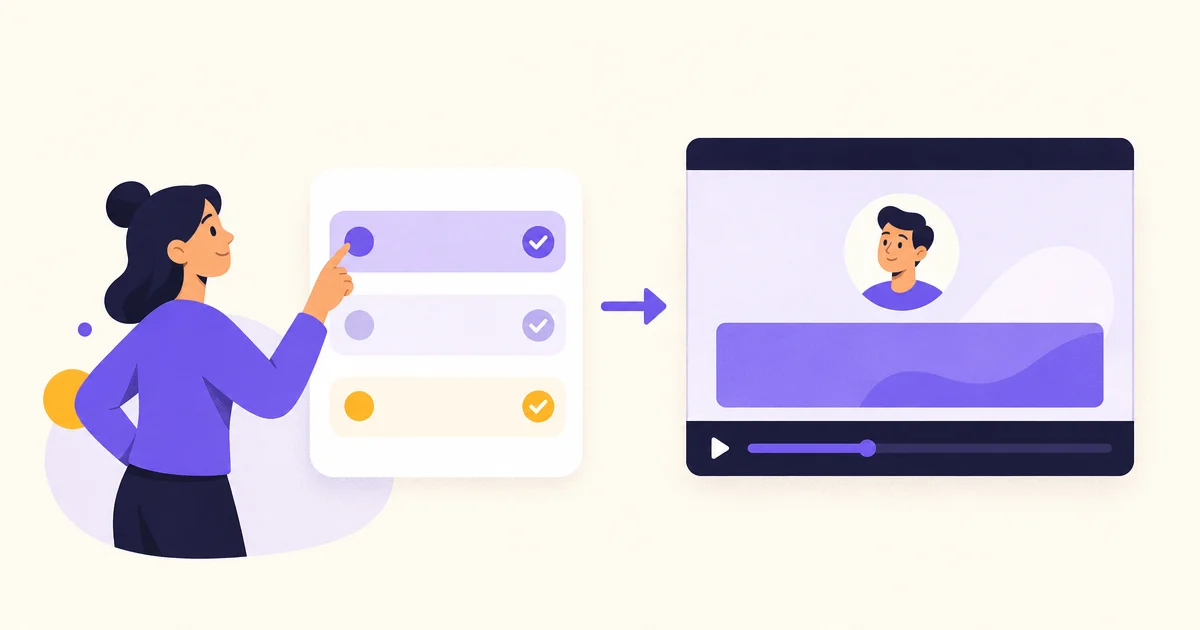
A video funnel starts from the same principle as an automated sales funnel: capture, qualify, convince without manual work at every step. It changes exactly one thing. What each prospect receives is no longer one email out of five written for everyone, but a video edited from what they just answered in a quiz. The one who hesitates on price sees an answer about price. The one worried about time sees an answer about time. The quiz is only the entry point. It's the video, built from real filmed segments and assembled according to the answers given, that does the work automation alone never gets to.
The exact mechanics of a video funnel, how that video gets assembled and what it actually does to a conversion rate, deserve their own deep dive. What matters here fits in one line: an automated sales funnel decides when to talk to someone. A video funnel also decides what to say. Twenty minutes after answering seven questions, a prospect who gets a video that speaks directly to their hesitation is in a different relationship with that message than the one opening the fourth generic email of the week.
Frequently asked questions
How much does an automated sales funnel cost?
Price mostly comes down to which tools get stacked together: a capture page, email software, a CRM, payment processing. A solo course creator can piece it together for thirty to a hundred dollars a month using mainstream tools. Dedicated all in one funnel platforms often start higher. The real cost, easy to forget, is the time spent writing the sequence and producing whatever content fills it.
What's the difference between a sales funnel and an automated sales funnel?
A sales funnel is the journey itself, capture, sequence, offer, whether or not a salesperson follows each lead by hand. An automated sales funnel specifies how it runs: without manual work at each step, through rules, tags, and sequences set up in advance. Every automated funnel is a sales funnel. The reverse isn't true.
Can an automated sales funnel run with zero human involvement?
Almost, but rarely all the way. Capture, tagging, and follow up run on their own once set up. Past a few hundred dollars in offer price, though, most sales still close on a call or a direct conversation. Automation gets the prospect to that moment. It doesn't replace it, except on simple, low priced offers.
Why can an automated sales funnel still convert poorly?
Usually because everyone gets the same message, regardless of what that person actually said. A vague promise on the capture page, a sequence that runs too long before the offer, or a follow up that ignores what the prospect already saw, any of these can chase off traffic that was otherwise qualified. The problem is almost never volume. It's content that speaks to no one in particular.
What sets a video funnel apart from a standard automated sales funnel?
The entry mechanism. Both qualify, follow up, and sell without manual work at each step. But a standard funnel sends the same content to everyone in a given bucket, while a video funnel builds a different video for each prospect from their quiz answers. Automation decides when to talk. A video funnel also decides what to say.