
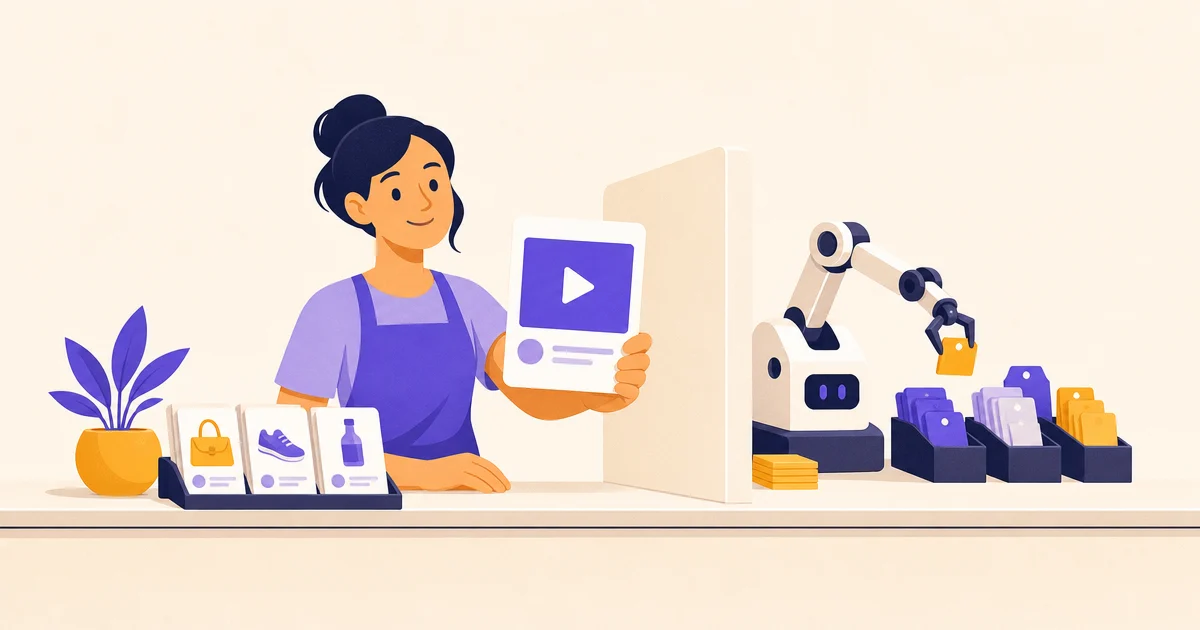
The AI and human balance in ecommerce is a question of placement, not dosage. Everything the buyer will never see belongs to the machine, all of it: forecasting, bidding, segmentation, ticket triage. Everything the buyer looks at stays human. Most brands are currently doing the reverse, and paying for it twice.
Half your customers already have an opinion about your AI
In October 2025, Gartner asked 1,539 US consumers a blunt question. Half said they would rather give their business to a brand that does not use generative AI in its messages, its advertising and its content. Not in its warehouse. In the things they read and watch. Gartner adds a second number that should worry anyone selling online: 68% say they regularly wonder whether what they are seeing is real.
That is not a rejection of AI as such, and the distinction is the whole game. Klaviyo's 2026 consumer trust report puts 85% of shoppers at some level of trust in AI to recommend a product, and only 54% at that same level for being helped by a conversational agent. Recommend, fine. Converse, no. The line sits between choosing and speaking.
Shoppers even name the tells. Two dominate in Klaviyo's research: a reply that lands too fast, cited by 50%, and a tone that reads too formal or too smooth, cited by 49%. The two things that give AI away are the two things you bought it for.
Pew Research Center surveyed 5,023 US adults in June 2025. 76% say it is extremely or very important to be able to tell whether pictures, videos and text were made by a machine or by a person. And 53% admit they cannot tell. An audience that demands to know and cannot tell goes suspicious by default. It stops taking your word for anything. It starts looking for proof.
Klarna learned this in public. In February 2024 the company announced that a conversational agent was doing the work of 700 support staff and handling 2.3 million conversations in a month. Fifteen months later, CEO Sebastian Siemiatkowski told Forbes that quality had slipped and started hiring people again. The dashboard tracked volume and cost with real precision. It never tracked what the customer walked away with.
The back office is where AI actually pays, and almost nobody puts it there
One MIT number sums up 2025 better than any trends deck. Across the generative AI deployments studied by its NANDA initiative, 95% produced no measurable return. The authors do not blame the models. They blame the allocation: more than half of budgets went into sales and marketing, while the real savings sat in operations, finance and admin. The money goes where it shows. The return sits somewhere else.
There is no sensible ceiling on the invisible side. Demand forecasting, reorder thresholds, price anomaly detection, attribute cleanup, catalogue translation, ticket triage and routing, abandoned cart scoring, campaign overlap detection: every one of those can be calculated and measured, and every one is better off automated. None of them puts your word in front of a customer.
Ad bidding is the clearest case. You stopped running it manually years ago, and a model now decides what you pay and who hears you, impression by impression. Meta pushed that further still, with effects we measured in Andromeda's effect on ecommerce ROAS. Nobody objects, because nobody sees it. That is the criterion, right there.
The back office has also never needed tightening this badly. IRP Commerce market data for July 2026 shows cost per session up 45% year over year, from 11p to 16p, while revenue per session gained 3.8%. Visitor numbers fell almost 14%. Each visit costs a great deal more and returns barely more. That gap does not close by hand.
The rule, and where it falls task by task
Here it is: give AI everything that can be calculated, keep the human for everything a customer looks in the eye. The test has nothing to do with how hard the task is or what it costs, and everything to do with whether it is visible. Invisible work goes over whole, with no ceiling and no guilt. Visible work stays, even when the machine would be faster.
Run it task by task with one question. If my customer found out tomorrow that this was done by a machine, would it change what they think of us? For a reorder forecast, no. For the apology after a damaged delivery, yes, and badly.
| Function | Goes to AI | Stays human |
|---|---|---|
| Advertising | Targeting, bidding, budget split, creative testing | The message, the face, the promise |
| Catalogue | Translation, attributes, cleanup, sorting, recommendation | The argument that closes the sale |
| Support | Triage, priority, order status, draft replies | The apology, the dispute, the angry buyer |
| Lifecycle | Triggers, timing, sequencing, segmentation | What the buyer actually opens |
| Stock and pricing | Forecasting, reordering, thresholds, anomalies | Nothing: the buyer never sees it |
| Selling | Qualification, scoring, routing to the right offer | The advice, the voice, the person explaining |
One row deserves a second look. Stock and pricing is the only line with an empty human column, and it is also the single most profitable thing on the list to hand over entirely. At the other end, selling reads both ways: the machine picks what to show, the person says why it matters. Neither column empties into the other. They grow together.
That line is moving toward you, too. More of your traffic now arrives after asking an AI its questions, opinion already formed, with no record of the conversation that formed it. We went through what that erases in converting ChatGPT traffic. The machine has done half a salesperson's job. What it has not done is be you.
Three ways teams put the line in the wrong place
Automating the voice before the numbers. The most common mistake, because it is the easiest one to start on a Monday morning. Product copy and subject lines get generated while reorder quantities are still worked out by hand in a spreadsheet nobody has rebuilt since 2019. The visible gain lands immediately. So does the cost, except it lands later and shows up on no report.
Confusing personalization with generation. Personalizing means picking, from material that already exists, what this specific person should see. Generating means manufacturing the material. The first needs data and some work up front. The second needs nothing, which is exactly why it wins arguments in meetings. Buyers feel the difference well before they can name it.
Measuring volume instead of quality. Klarna tracked conversations handled and cost per ticket with real rigor. Nobody tracked what customers came away with at the same rigor. MIT found a matching gap across 2025 AI projects: roughly a third succeed when a company builds alone, and two thirds when it works with a partner who does this for a living.
The setup that holds both ends
The rule is easy to say and awkward to live with, for a dull reason: most tools make you pick a side. A product page scales forever and says nothing personal. A salesperson on a call convinces and does not duplicate. A video funnel is the shape that refuses to choose.
Three steps, and there is a fuller account of what a video funnel actually is elsewhere on this blog. A visitor answers a qualification quiz. Those answers drive the assembly of an analysis video cut for that person, ten minutes or so, built from segments that were genuinely filmed. It reaches them shortly after, followed by automated follow-ups and a clean handoff into the CRM.
Look at where the line falls inside that. Everything the buyer does not see is machine, down to the last setting: an AI builds the funnel, writes the assembly conditions, wires the follow-ups and runs the whole thing. Everything the buyer does see is human, down to the last shot. No avatar, no synthetic voice, no manufactured face. A seller talking, and a machine deciding which of their sentences this person needs.
The shift shows up in the numbers of the brands running it. BodyTime, which sells training programs, asks 14 questions and sends back 13 minutes of video: conversion rate multiplied by 2.5 on the same traffic, with thirteen minutes of attention captured before the offer even appears. Anna Velazia, in jewelry, moved 70% of ad budget onto the channel, which became its first acquisition lever, at three times the ROAS of its other campaigns. Those numbers belong to those two brands and are not an average. They do point the same direction every time, though, and it is the direction where somebody actually talks to the customer. There is a full breakdown of what a video funnel repairs across an ecommerce chain.
The objection always lands in the same spot: you have to film. You do. Two to four hours depending on how fine the analysis goes, a recent phone and decent light, with the technical roughness working in your favor because roughness is what proves a person was there. It is the one link in the chain a competitor cannot copy in an afternoon of prompting. That is precisely what makes it worth something.
Here is the 2026 paradox, and it is good news. The deeper AI goes into operations, the more the little that stays visible is worth, and the better the return on putting a person there. Your competitors will keep automating the storefront, because that is what demos well. You can do the opposite: hand the entire back office to the machine, and put a face back in front. A buyer who watches twelve minutes of video to the end knows a person filmed it for people like them. The machine that assembled it shows up nowhere. That is its job.
Frequently asked questions
Should I use AI to write product descriptions?
For attributes, translation, structure and catalogue cleanup, yes, without hesitation: none of that is visible. For the argument that has to convince someone, keep your hands on it. Half of US consumers say they prefer brands that keep generative AI out of what they read (Gartner, March 2026). Apply the rule block by block, not page by page.
Does an AI chatbot cost you sales?
It costs you sales when it carries the conversation all the way. In Klaviyo's 2026 report, 85% of consumers extend some trust to AI for product recommendations, but only 54% do for being helped by a conversational agent. Let it triage, prioritize and draft. Have a person sign off, especially on a dispute.
How do I know if customers can tell my content is AI-generated?
They tell you the tells themselves: a reply that arrives too fast, flagged by 50% of them, and a tone that reads too formal or too smooth, flagged by 49% (Klaviyo, 2026). Reread your last campaign with those two questions in mind. If both signals are there, your reader decided before you did.
How much of my store can I automate safely?
All of what the buyer never sees: forecasting, reordering, bidding, segmentation, ticket triage, anomaly detection, scoring. There is no ceiling on that side, and that is where the return lives, as MIT measured in 2025. The risk starts at the exact moment the machine speaks to a customer.
Should I disclose that I use AI?
On invisible work the question does not arise: nobody asks who calculates your reorder points. On anything visible, 76% of Americans say it matters to them whether an image, a video or a piece of text came from a machine or a person (Pew Research Center, September 2025). The simplest answer is still to show them somebody.