
AI personalization moves campaign metrics. It moves the buyer's sense of being understood much less. In 2025, 71% of companies used AI to personalize customer interactions, and 42% of their customers found those interactions personalized (Twilio, 2025). Your return sits inside that gap, not in the number of segments you run.
The lift numbers everyone quotes, and the year they were measured
In December 2019, Gartner published a forecast that traveled well: by 2025, 80% of marketers who had invested in personalization would walk away from it, beaten by weak returns or by the cost of managing customer data. That deadline has come and gone. Nobody walked away.
What happened instead is more useful to know. Personalization was expensive because it needed variants. Five segments meant five versions of the message, five sets of creative, and someone to run the whole thing. Generative AI collapsed that cost, and Gartner's arithmetic depended on it. The ROI question has changed shape since. It now rests on one thing: does the buyer notice?
The numbers used to defend personalization budgets have not moved at all. The one everybody cites comes from McKinsey's Next in Personalization report, published in 2021: faster-growing companies pull 40% more of their revenue from personalization than slower growers. The same study found 71% of consumers expecting personalized interactions and 76% getting frustrated when they do not get them. All of it was measured before ChatGPT, before customer data platforms came within reach of small teams, before a message variant cost a fraction of a cent. It still gets pasted into 2026 decks as current.
The most recent estimate belongs to Boston Consulting Group, which put the prize in 2024 at $2 trillion of revenue changing hands over five years, with personalization leaders growing 10 percentage points faster each year than laggards. Handle that one carefully. It models potential value rather than measured gain.
So the evidence on the company side is thin: plenty of self-reporting, a few models, very little published incremental lift. The buyer side has better data, and almost nobody puts the two next to each other.
Why buyers reject personalization they never asked for
YouGov's 2025 report on personalized advertising, run with 1,503 US adults between December 2024 and January 2025, found 54% of them saying personalized ads creep them out, 56% uncomfortable with companies using their online behavior that way, and 18% comfortable with it. In Britain the discomfort reaches 57%. Set that against McKinsey's 71% who expect personalized interactions and the contradiction looks total.
It is not one. The two surveys ask about different things.
What buyers push back on is inferred personalization: the kind assembled from browsing history, a pixel, a data match, a guess nobody confirmed. They meet it by being on the receiving end, and they draw the obvious conclusion, which is that they were watched.
Declared personalization runs the other way. Someone who answers seven questions about their situation knows exactly what they handed over and why. They expect something back for it. The gap between being tracked and being listened to shows up directly in acceptance rates.
Behavioral tracking paid extremely well for fifteen years. It pays less every quarter: browser blocking, mobile opt-outs, 54% declared discomfort, and thinner signal as the big platforms close their boxes. Building your personalization on data the customer never handed you means investing in a depreciating asset.
The gap that decides your return
Twilio surveys consumers and business leaders every year on the same questions, which makes the drift between them measurable. The 2025 edition covers 7,640 consumers and 637 leaders across 18 countries, surveyed in January and February. It gives the sharpest picture available, and the picture is a widening gap.
| What is measured | Company side | Buyer side | Source |
|---|---|---|---|
| AI used for customer engagement | 71% of companies use it | 42% find the interaction personalized | Twilio, 2025 |
| Customer understanding | 83% of leaders claim deep knowledge of customers | 45% feel understood, down from 46% in 2024 | Twilio, 2025 |
| Right content at the right moment | the promise of every data platform | 2 in 3 consumer brands miss it | Adobe, 2025 |
| Personalized advertising | 14% of the marketing budget back in 2019 | 54% creeped out, 18% comfortable | Gartner, 2019 and YouGov, 2025 |
Read the second row twice. Eighty-three percent of leaders believe they know their customers deeply, and 45% of those customers feel understood. Nearly forty points apart. No tool closes a hole that size, because the hole is not a tooling problem: companies measure what they send, buyers judge what they receive, and the two stopped matching a while ago. Adobe reached the same place from another direction in its 2025 report on AI and digital trends, where two out of three consumer brands fail to deliver the right content at the right moment.
For an ecommerce operator the buyer column is the one that pays rent. In the same Twilio survey, 71% of consumers say they walk away from a purchase when the experience does not feel relevant to them.
What AI makes free, and what stays scarce
Take it as an economics problem. A competitive advantage rests on scarcity. For a decade, personalizing was scarce because it was expensive: clean data, a platform, variants to produce, a team to hold it together. AI personalization removes the last three.
By 2027 your competitor will produce five thousand message variants for the price of one. So will you. So will the store next door. Once everyone holds the same capability at the same cost, it stops being an edge and turns into a floor: you install it to avoid falling behind, not to win. Generated personalization is following the path mobile-friendly layouts and two-day shipping already took.
Which leaves the question worth asking: what cannot be generated?
One thing. Proof that a human spent time on your case. A model writes a message that passes for personal attention, and it writes a better one every month. It cannot produce the fact that a real person sat down in front of a camera to answer a situation like yours. That is an expensive signal, and it works precisely because it costs something to send.
The video funnel is built on that observation. A visitor answers a quiz about their own situation, then receives an analysis video assembled from those answers out of segments a human actually filmed. The full definition and mechanics sit in What is a video funnel? Definition, mechanics and 2026 data.
Splitting the labor is what makes it hold at scale. AI does what AI does well: read the answers, score them, pick the segments, assemble, deliver, follow up, push the lead into the CRM. The human keeps the one part nobody can hand off, which is talking. No avatars, no synthetic voice, no generated footage. The moment a buyer suspects the face is not real, the whole effect goes.
Personalization the buyer asked for
Up close, a video funnel gets built like a sales conversation recorded once and reused forever. The quiz runs five to fifteen questions, each one asked by a video of the seller. The prospect answers, and every answer commits them a little further. Then the video arrives, ten to fifteen minutes edited for that profile, usually within two hours.
Combinatorics is where the economics come from. Five questions with three options each produce hundreds of possible paths from around twenty filmed segments. You shoot for two to four hours depending on how fine the analysis goes, spend about thirty minutes on setup, and then answer thousands of situations without going back to the camera. Shooting is the entry price, and it is exactly what your competitors will keep skipping.
Two numbers, attributed to the brands that reported them and not to be read as averages. BodyTime sells training programs, asks fourteen questions about goals and sends back thirteen minutes of video; the brand reports a conversion rate multiplied by 2.5 on the same traffic, with thirteen minutes of attention captured before the offer even appears. Anna Velazia, in jewelry, asks about emotional state and sends back twelve minutes: 70% of the ad budget moved onto that funnel, now their first acquisition channel, at three times the return on ad spend of their other campaigns.
Both cases share one number: watch time. Thirteen minutes watched voluntarily is an order of magnitude no product page reaches and no email approaches. The forces at work in that window, commitment, reciprocity and consistency, have forty years of social psychology behind them, and we walked through them in Persuasion principles in marketing: the three forces, and what your funnel does with them.
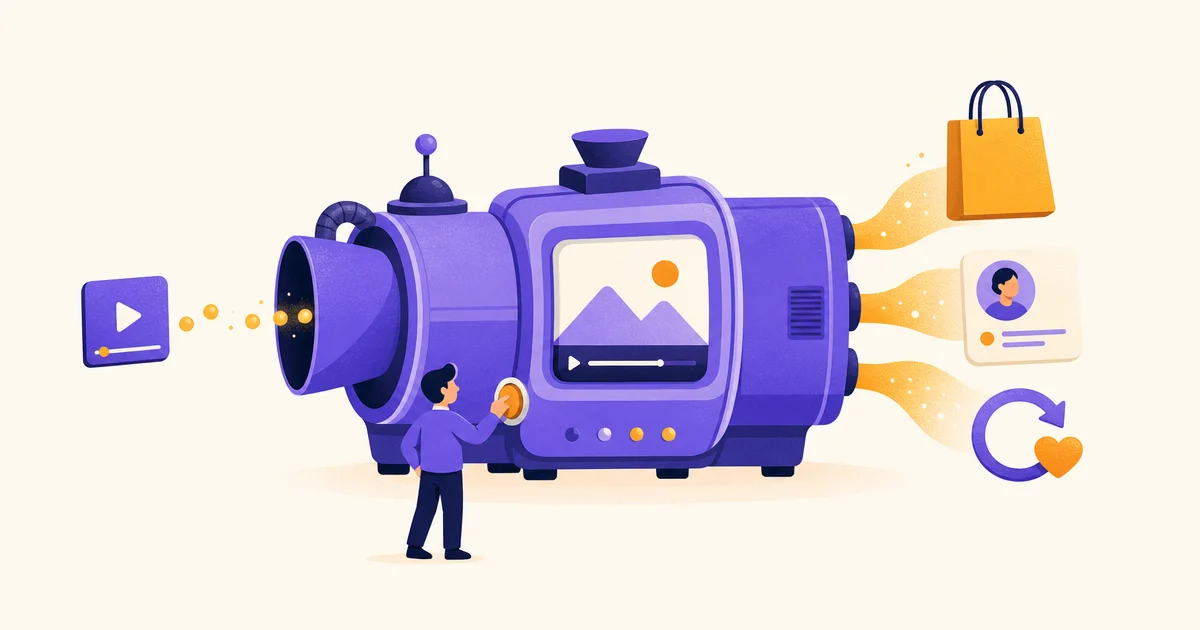
The effect then spreads along the rest of the chain: less dependence on retargeting, a contact list you own, follow-ups that know what they are talking about. The line-by-line version is in Video funnel for ecommerce: one machine that fixes ads, conversion and retention.
What you decide in the next twelve months
Run the exercise backwards. Write down what your closest competitor will have in 2027: the same generative model, the same data platform, the same micro-segments, the same ability to ship a thousand variants before lunch. Cross all of it out. Whatever survives on the page is your actual advantage.
For most brands, nothing survives. For the ones who filmed, what survives is a face, a voice and a way of explaining a product that nobody copies in three prompts. That asset appreciates as everything around it gets cheap.
Sequence matters more than teams expect. Plenty of them fix the data first, wire up the AI second and think about content third, which lands them in front of a camera two years later, exhausted, at the exact moment everyone else has caught up. The sequence that works starts with the question you will ask the visitor and the answer you owe each combination of replies. The rest automates.
One more reason to start this year: a growing share of your visitors now arrive after asking an AI about you, with an opinion already formed and no record of the conversation attached. What that traffic erases on the way in, and what a video funnel hands back, we measured in Convert ChatGPT traffic when the click lands on your homepage. AI personalization will give you the right message. It will not give you someone to talk to.
Frequently asked questions
What is the ROI of AI personalization?
On campaign metrics it is real: opens, clicks and average order value all move. On the relationship it is much weaker. Twilio measured in 2025 that 45% of consumers feel understood by brands, down from 46% the year before, while 96% of companies said AI was improving their customer operations. The lift exists, and it dilutes as everyone obtains it.
Is hyper-personalization different from personalization?
Classic personalization adapts a message to a segment defined in advance, such as new customers or buyers in one category. Hyper-personalization goes down to the individual and to real time, combining browsing, purchase history and context. The shift is about the volume of variants produced rather than the nature of the signal, which is why it hits the same trust ceiling.
Why do buyers find personalization intrusive?
Because they did not hand over the information themselves. YouGov found in 2025 that 54% of US adults are creeped out by personalized ads and only 18% are comfortable with them. The same buyer will happily answer a questionnaire about what they need, because they know what they gave and they expect an answer in return.
Do you need a data team to personalize in 2026?
No. Generative models and data platforms dropped the entry cost far enough that the constraint moved elsewhere. The bottleneck is content production: five thousand micro-segments demand five thousand answers. A filmed answer, reusable through combination, carries that load better than a library of written variants.