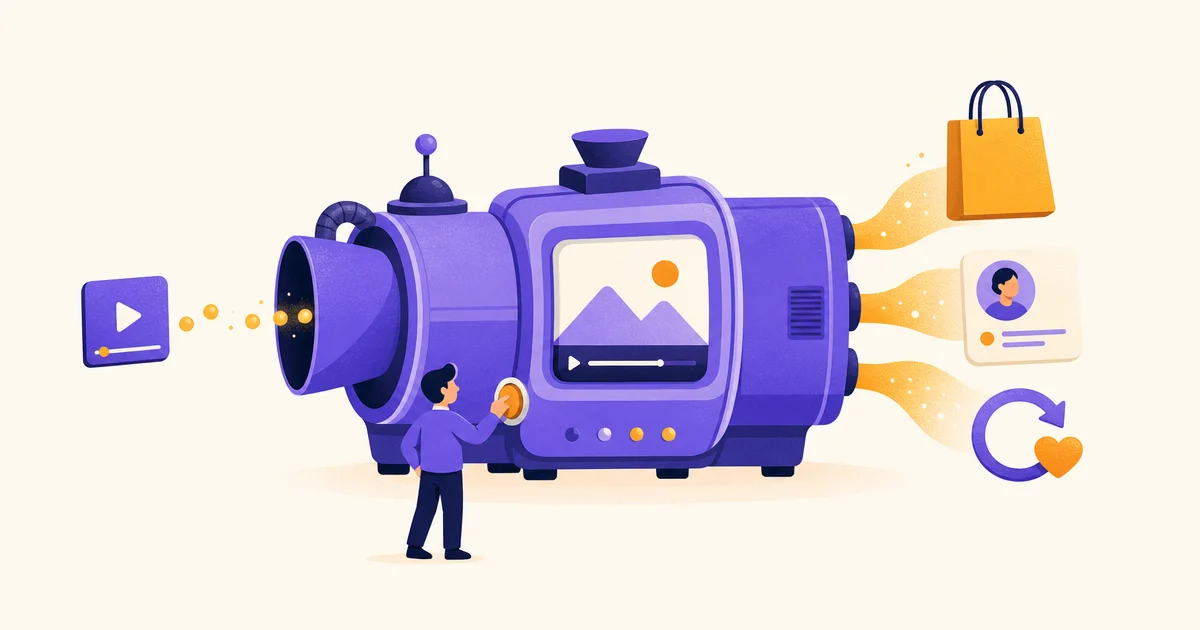
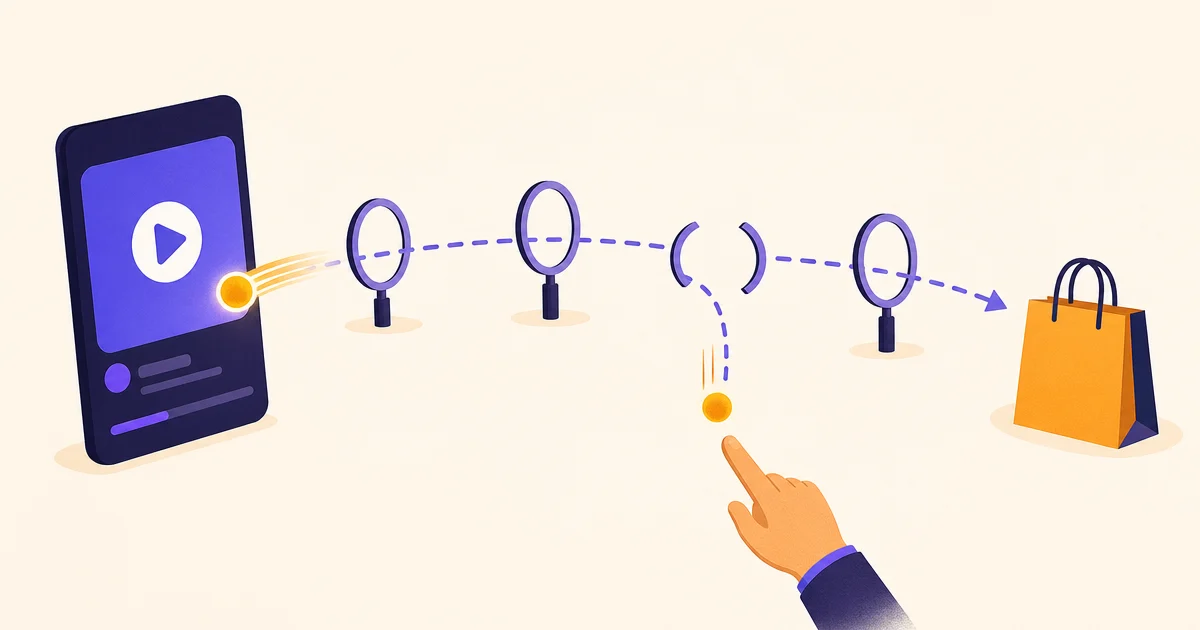
The most common cause fits in one sentence: TikTok Ads sells curiosity, and your page expects intent. Impressions are cheap, a share of the clicks are reflexes, and the visitor who lands hasn't decided to buy anything yet. The four-step diagnosis below tells you exactly where the sale escapes, and what holds onto it.
How to tell where the problem comes from
Before you touch creatives or budget, four checks, in order. Each takes under ten minutes in your reports, and each maps to a step of the journey where the sale can leak.
- Is the click a real click? Compare click count to landing page views. A wide gap means reflex clicks.
- Is your page waiting for a customer who doesn't exist? Look at time on page and bounce rate for TikTok traffic, isolated from other sources.
- Who's doing the salesperson's job? Look, between arrival and checkout, for the moment someone asks the visitor a question. If there isn't one, you've found the leak.
- Does the follow-up talk to anyone? Open your retargeting and email sequences: are they identical for everyone, or do they pick up what the visitor said?
The rest of this piece walks through those four steps with the numbers behind them and the fix that goes with each. Most accounts find their problem at step three.
Step 1: is the click a real click?
Start with what TikTok does very well: getting seen. Across the 5,900 brands tracked by Triple Whale from August 2025 to July 2026, the average TikTok Ads CPM is $4.08, almost four times cheaper than Meta's $15.06. Views are cheap, hence the climbing counters. But average CTR drops to 0.61%, where Meta posts 2.39%, and average ROAS sits at 1.51 against 1.88. Lots of people watch. Few click. And those who click buy less.
A share of those clicks was never a decision. According to TikTok data relayed by the agency Gupta Media, 60% of clicks on a video happen within the first six seconds, and more than 36% within the first two. Two seconds is the time it takes a thumb to slip. Those visitors reach your page without meaning to, and leave before it finishes loading.
The check is mechanical: divide landing page views by clicks. So is the fix: TikTok offers optimization for landing page views rather than clicks, which favors users likely to stay. You'll lose click volume and gain visitors. That's the right trade.
Step 2: is your page waiting for a customer who doesn't exist?
The TikTok visitor who actually meant to click still isn't a buyer. They come from an entertainment feed, they saw fifteen seconds of a product they weren't looking for, and they're curious. Yet the page that receives them was almost always designed for a different profile: the one who typed the product name into a search engine and is comparing prices. Headline, benefits, buy button. An intent page, served to discovery traffic.
The mismatch shows in the numbers. A landing page converts 6.6% of its visitors at the median (Unbounce, Q4 2024), and that benchmark blends every source, including the highest-intent ones. For traffic that's discovering, the step is higher still. The curious visitor isn't refusing to buy: they simply have nothing to carry them from "huh, interesting" to "this is for me." The page asks for a decision they didn't come to make.
Check time on page and bounce for TikTok traffic, isolated. If it holds a few seconds and leaves, the page doesn't speak its language. The fix isn't a prettier page. It's a page that starts by welcoming curiosity instead of demanding intent.
Step 3: who's doing the salesperson's job?
Here's the leak most accounts discover. Between the view and the sale, a job has to get done: turning a curious person into a buyer. In a store, the salesperson does it, with two questions and a recommendation. Online, on most TikTok funnels, nobody does. The video created the want, the page presents the product, and the passage from one to the other is left to the visitor alone. They don't make it. Not out of refusal, out of lack of help.
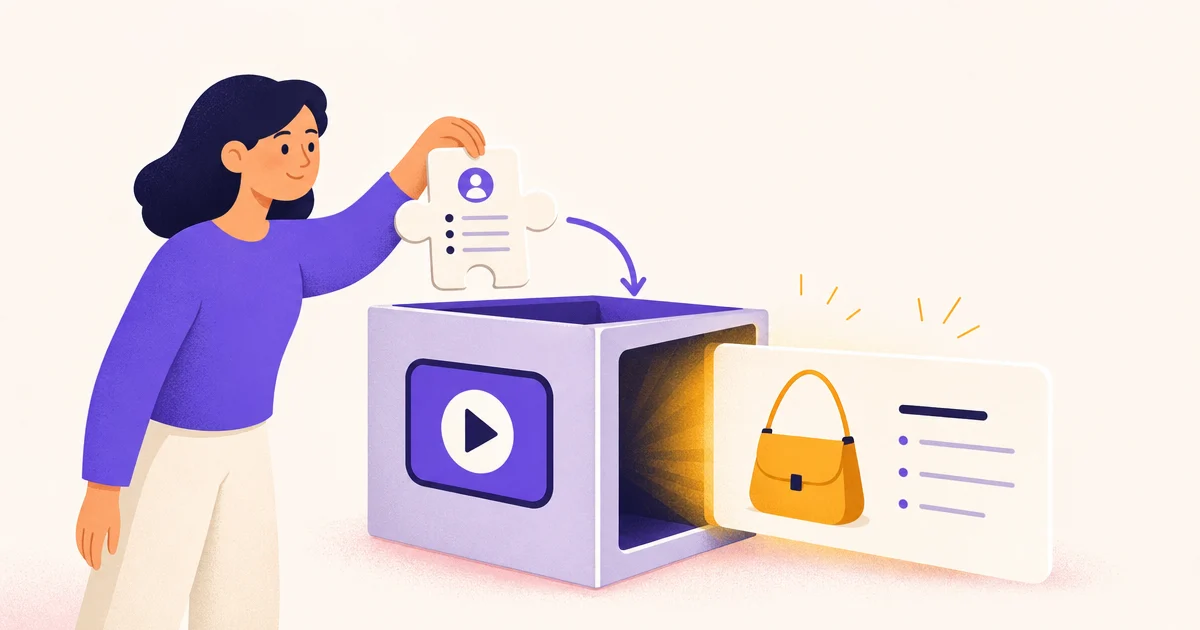
That's exactly the role of a video funnel, and it's for this traffic that it matters most. Instead of a product page, the click opens a short quiz that does two things at once: it gives the curious visitor something to do with their curiosity, and it reveals what they need. The format holds this kind of visitor: 37.6% of people who start a quiz in ecommerce leave their contact details (Interact, 2026). Across 45 million responses, RevenueHunt (2026) measures that 5.5% of those who finish a recommendation quiz place an order, with carts 11 to 15% above average.
Then the personalized analysis video takes over: 10 to 15 minutes assembled from the answers, actually filmed by the brand, recommending the right product and arguing for it to this specific person. The curious visitor from TikTok receives what the product page couldn't give them, a salesperson. BodyTime, a fitness program company, holds 13 minutes of attention this way before its offer even appears, with conversion multiplied by 2.5 on the same traffic. Anna Velazia, a jewelry and lithotherapy brand, made it her top acquisition channel with 3x the ROAS. Figures belonging to those two accounts, but the mechanism is the one discovery traffic demands: the video funnel for ecommerce details every step.
Step 4: does the follow-up talk to anyone?
Last check, the one people skip because it looks handled: retargeting. The TikTok visitor who didn't buy will see your ads again, and get your emails if you have their address. But what will you tell them? On a classic funnel, the same thing you tell everyone, because you know nothing about them: they watched a video, they clicked, they left.
The contrast with a follow-up that knows who it's talking to is measured. Across 183,000 brands analyzed by Klaviyo in 2026, a generic email campaign gets 1.69% clicks and 0.16% conversion; automated flows triggered by behavior climb to 5.58% clicks and 2.11% conversion, thirteen times more orders. The difference isn't the tool, it's the information: a flow knows what the contact did.
A video funnel produces precisely that information. Every quiz answer lands in the CRM, and the follow-up can pick the diagnosis back up where the prospect left it: their goal, their sticking point, the product recommended. The curious visitor from TikTok is no longer an anonymous address in a retargeting audience. They're someone whose question you know, and whom you can answer a second time.
What won't fix it
Three false leads come up in every account struggling on TikTok. Producing more creatives: that revives views, which is the part of the journey that already worked. Cutting TikTok to go back to Meta: impressions cost four times more there, and the problem of advice after the click is exactly the same. Raising the budget: you then buy more curiosity to pour into the same funnel that does nothing with it.
TikTok holds up its end of the deal: cheap views, at volume, in front of people who didn't know you. What the platform delivers is called curiosity, and it's an excellent raw material as long as you work it. The account that gets views but no sales doesn't have a TikTok problem. It has a missing salesperson between the click and the cart, and that's exactly where personalized video for ecommerce changes the numbers most.
Frequently asked questions
Why do my TikTok Ads get views but no sales?
Because TikTok delivers discovery traffic, curious but undecided, to a page built for visitors who already intend to buy. The numbers show it: $4.08 CPM but 0.61% CTR and 1.51 ROAS across 5,900 brands (Triple Whale, 2026). The sale leaks after the click, at the point where nobody plays the salesperson.
What's a good conversion rate for TikTok Ads?
The average conversion rate Triple Whale measured across 5,900 brands from August 2025 to July 2026 is 1.56%, with a $17.07 cost per acquisition and a 1.51 ROAS. Industry spreads are wide, from 0.38% to 2.08%. Above 2% you're already in the top tier; below 1%, look for the leak in the journey after the click.
Do I need a dedicated landing page for TikTok Ads?
Yes, but not in the sense of a prettier page: a page that welcomes curiosity instead of demanding intent. The TikTok visitor didn't search for your product, they ran into it. A quiz that asks them two or three questions, followed by a personalized analysis video that recommends and argues, does the salesperson's job a product page can't.
How does a video funnel improve sales from TikTok?
It turns curiosity into a decision. The quiz holds the visitor and reveals their need (37.6% of people who start an ecommerce quiz leave their contact details, Interact 2026), then a personalized analysis video, actually filmed, recommends the right product to that person. The answers flow to the CRM and make the follow-up precise instead of generic.