
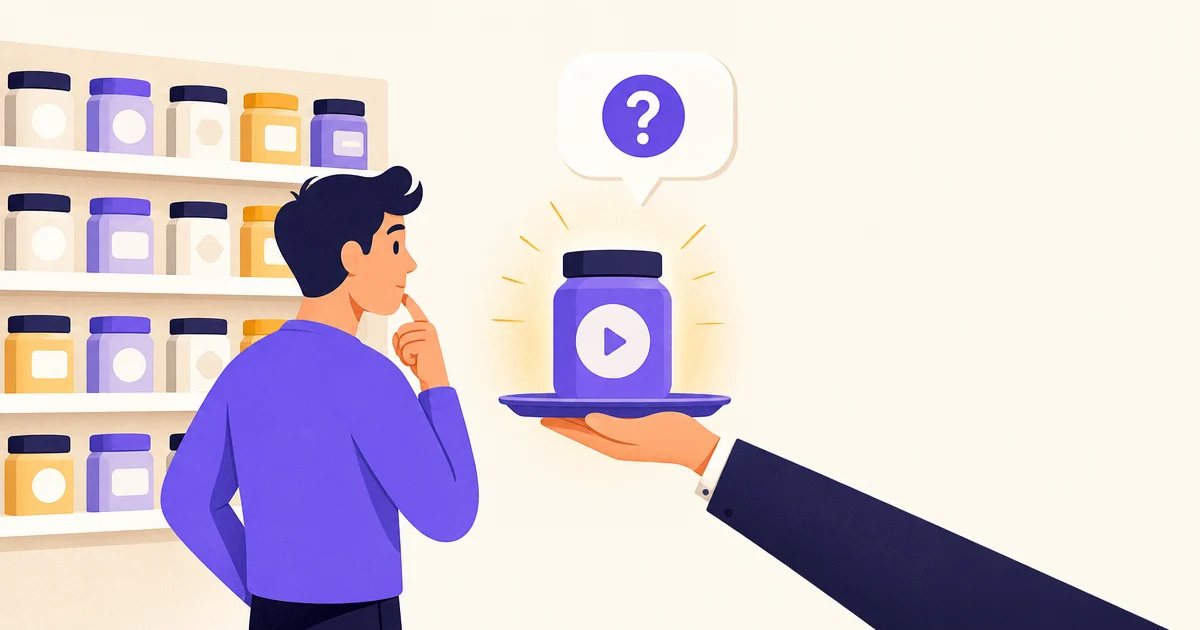
The paradox of choice is the counterintuitive mechanism by which, past a certain point, adding options attracts more visitors but produces fewer buyers, because deciding becomes too costly. In ecommerce it isn't fixed by cutting the catalog: it's fixed by guiding the choice, the way a salesperson would in a physical store.
The jam legend, and what it actually says
The story has been told to exhaustion: in a California supermarket, Sheena Iyengar and Mark Lepper set up a tasting table, sometimes with 6 jams, sometimes with 24. The big table drew more shoppers. At the register, the verdict flipped: 30% of tasters at the small table bought a jar, against 3% at the big one (Iyengar and Lepper, 2000, Journal of Personality and Social Psychology). Ten times fewer sales, with more people.
The detail most retellings drop is the most useful one: the two tables don't lose the same game. The big assortment wins the battle for attention; it makes people stop. It loses the battle for the decision. Every online store lives inside that exact tension: the wide catalog brings people in, and something between the collection page and checkout makes them give up.
What the science has verified since
Twenty-five years on, where does the evidence stand? The honest answer: choice overload is not a universal law. In 2010, Scheibehenne, Greifeneder and Todd combed through 50 experiments and 5,036 participants: the average effect came out close to zero. Plenty of contexts handle large choice just fine. If you've read that too much choice always kills the sale, that was too simple.
What came next is more interesting. In 2015, Chernev, Böckenholt and Goodman reworked 99 observations and 7,202 participants and settled the debate: choice overload is real, under conditions. Four factors trigger it: assortment complexity, decision task difficulty, the customer's uncertainty about their own preferences, and the drive to minimize effort. When all four dials turn up, the jam effect comes back.
Read those four conditions slowly. Technical products that are hard to compare. A decision that commits a real budget. A customer who can't articulate what they need. And the universal online urge not to spend the whole evening on it. That's not a lab protocol. That's a mattress, skincare or equipment product page at 9:40pm.
Why your store checks all four boxes
The market's reflex against overload is the filter: faceted, by price, by use case, by color. Useful, but look at who's doing the work: the customer. Filtering assumes you already know what you're looking for, which means having solved Chernev's condition number three, preference uncertainty. The visitor who needs help is precisely the one who doesn't know what to type into the filters. The tool serves the decided and abandons the hesitant, who are the silent majority of your traffic.
The hesitant shopper doesn't say no. They say later, they open a competitor's tab, they save the cart for the weekend. Choice abandonment is a postponement, not a refusal, and that's what makes it expensive: you paid for the click, won the attention, and lost the decision. Just like the big jam table.
So should you cut the catalog? No, and the nuance matters: a wide assortment feeds SEO, covers the long tail and signals a serious operation. The shelf can stay deep. It's the moment of choice that has to become narrow. Physical retail has reconciled those two demands forever through one person: the salesperson, who listens for two minutes and then puts three products on the counter. Nobody ever asked them to shorten the shelf.
Narrow the choice at the right moment, not the catalog
Rebuilding that salesperson online takes two moves, in this order. First a diagnosis: a short quiz that does what the filter can't, reveal the customer's preferences to themselves. The format is proven at scale: 69% of visitors who start a recommendation quiz finish it, 5.5% of finishers place an order, roughly 2.75x the average store rate. Their carts also run 11 to 15% above normal (RevenueHunt, 2026, 45 million responses). A diagnosed customer buys more, because they no longer have to decide alone.
Then a recommendation someone stands behind. That's where the video funnel goes further than the quiz alone: the answers assemble a personalized analysis video of 10 to 15 minutes, actually filmed by the brand, which recommends the right product and argues the choice, on camera. Chernev's overload gets attacked on all four sides at once: complexity collapses (one recommended product instead of forty), the task disappears (someone decided), uncertainty dissolves (the diagnosis put it into words), and the effort is zero (all that's left is to watch).
Anna Velazia sells jewelry and lithotherapy, a nearly infinite shelf where every stone is chosen on intuition: the textbook case of the impossible choice. Her video funnel, 14 questions about emotional state followed by 12 minutes of personalized video, became her top acquisition channel, carrying 70% of the ad budget with 3x the ROAS of her other campaigns. Those figures belong to that account; the mechanism holds for any online store where advice drives the purchase.
A wide shelf, an outstretched hand
The paradox of choice doesn't demand a poorer offer. It demands that you stop leaving the customer alone in front of it. The levers that make people follow a recommendation, the commitment of the quiz, the reciprocity of a video prepared just for them, are the same ones our piece on persuasion principles in marketing lays out; they ask for only one thing, a moment where the brand takes charge of the decision.
Keep the twenty-four jams on the table if you like. But when the customer stops, someone has to hand them one, and say why that one. Online, that gesture has a name: a quiz that listens, a video that recommends. The rest of the catalog never needed to disappear. It needed a salesperson.
Frequently asked questions
What is the paradox of choice?
The idea, popularized by psychologist Barry Schwartz in 2004, that beyond a certain number of options choice becomes a cost: deciding gets harder, fear of choosing wrong rises, and the purchase gets postponed. Iyengar and Lepper's founding experiment (2000) illustrates it: a table with 6 jams converted 30% of tasters, against 3% for a table with 24.
Is the paradox of choice scientifically proven?
Under conditions, yes. A 2010 meta-analysis (Scheibehenne et al., 50 experiments) found a near-zero average effect, but Chernev et al. (2015, 99 observations) showed it becomes significant when four factors combine: complex assortment, difficult decision, uncertain preferences, and effort minimization. That's the portrait of a high-commitment online purchase.
How many products should an online store offer?
There's no magic threshold, and the research validates no universal number. The lever isn't catalog size but the moment of choice: a wide assortment can stay on the shelf for SEO and the long tail, as long as an advice mechanism narrows the customer's decision down to one or two argued products.
How do you reduce choice overload without cutting your catalog?
By diagnosing before recommending. A recommendation quiz reveals the customer's preferences to themselves, then a personalized analysis video recommends the right product and argues the choice. Quizzes convert 5.5% of finishers with carts 11 to 15% above average (RevenueHunt, 2026); the video adds what the quiz alone lacks, a salesperson who decides.