Customer acquisition cost is a division: what you pay for a click, divided by the share of clicks that turn into customers. The auction sets the first term and raises it every year. The second one is entirely yours. Doubling your conversion rate halves your CAC, on exactly the same budget.
CAC is a division, and you only work one term
Customer acquisition cost fits inside a division. On top, what you pay to bring a visitor in. Underneath, the share of those visitors who buy. Divide, and you have your CAC. Nothing else enters the formula.
Now look at who holds each term. The price of a click is set in an auction where your competitors decide as much as you do: they raise their budgets, you pay more, without having changed a thing. The conversion rate plays out entirely inside your funnel, between the click and the checkout. Nobody else can reach it, and no competitor can bid it up.
Yet the market spends most of its energy on the term it doesn't control. Audiences, creatives, exclusions, campaign settings, budget calls: all that work aims to pay slightly less per click in an auction that rises anyway. Meanwhile the denominator hasn't moved in years.
What the auction takes from you every year
The 2026 data leaves little hope on the numerator. Triple Whale tracked more than 40,000 brands from August 2025 to July 2026: average Meta CPM reached $15.06, up 13.24% year over year. Tinuiti's benchmark report for the second quarter of 2026, built on more than $4 billion in ad spend under management, points the same way: CPM up 10% across Meta, 13% on Facebook alone, and 83% on Reddit after 71% the previous quarter.
The rise isn't the worrying part. What it runs into is. Over the same period and the same sample, the average conversion rate fell 4.73%. Clicks cost more and convert less: both terms of the division are working against you at once.
Stretch the timeline and the gap becomes structural. SimplicityDX measured that between 2013 and 2022, the average loss a brand takes on each newly acquired customer went from $9 to $29, a 222% rise in eight years. Acquisition has never been this expensive, and nothing suggests the auction is coming back down.
Same budget, two outcomes: the full calculation
Nothing beats running the numbers all the way through. Take a $10,000 monthly budget and the market averages quoted above: a $15 CPM, a 2.39% click-through rate, a 1.53% conversion rate.
Year one. Your $10,000 buys 667,000 impressions, which produce 15,900 clicks at 63 cents each, of which 244 become customers. Your CAC lands at $41. That's your starting point.
Year two, same budget, same page, and 13% CPM inflation. Your $10,000 now buys only 590,000 impressions, so 14,100 clicks. At an unchanged conversion rate, 216 customers. CAC climbs to $46. You just lost 28 customers a month without making a single mistake.
Run that same year two again, with the same inflation and the same 14,100 clicks, but a conversion rate lifted to 3.06%. Those clicks produce 431 customers. CAC falls to $23, 44% below where you started, with the inflation absorbed on top. Same budget. Same auction. Nearly twice the customers.
The middle line is the one to remember. To neutralize 13% CPM inflation, you only need conversion to move from 1.53% to 1.73%. Two tenths of a point: that's the price of a full year of ad inflation, and it's paid on the far side of the click.
The only ground you actually own
There's a deeper reason to prefer that ground, beyond the arithmetic. Any gain won on the price of a click is immediately put back in play: your competitor bids higher next month, the platform reprices, the advantage evaporates. A point of conversion rate can't be bid away. It stays in your funnel, it applies to every click you buy afterwards across every channel, and it stacks with whatever savings your media team wins on their side.
It also isn't indexed to anything. CPM follows your competitors and rises when they spend; a software subscription costs the same in January and in December. In a market where traffic gets 13% more expensive each year, a fixed cost that raises the value of every click becomes a shield by simple arithmetic. VideoFunnel starts at €197 a month with no commitment, pricing current as of August 26, 2026. Set that fixed line against what thirteen percent of inflation takes out of a media budget every year.
The argument holds across every channel at once. The returns dented by Meta's Andromeda shift, the TikTok views that never convert, the Google click that costs more: three symptoms, one shared cause. A single repair covers all of them, because it sits after the click, where every channel meets.
Multiplying the value of a click you already paid for
That leaves the hard part: how you actually double a conversion rate, because the sentence is easy and the move is not. The answer sits in what a classic funnel is missing: between the click and the checkout, nobody talks to the visitor. They land on a page that presents a product, and they leave if they weren't already decided. A landing page converts 6.6% of its visitors at the median (Unbounce, Q4 2024). The other 93 were bought at full price and return nothing.
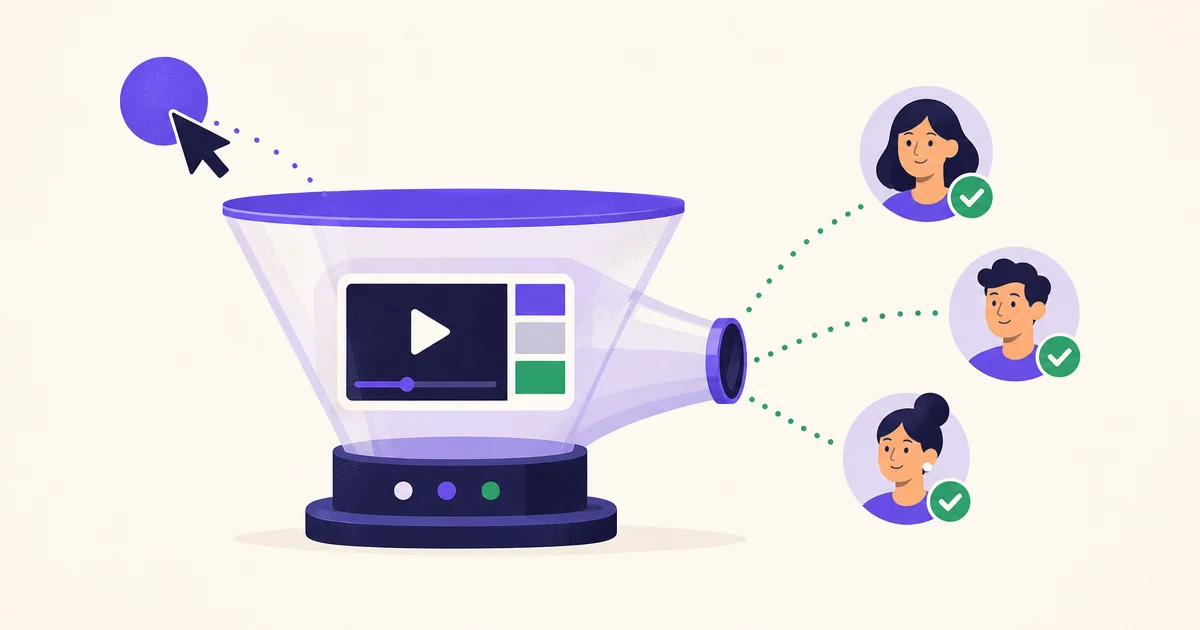
That's exactly the job of a video funnel. The click no longer opens a product page but a short quiz, which holds the visitor and reveals what they need. Their answers then assemble a personalized analysis video of 10 to 15 minutes, actually filmed by the seller, recommending and arguing for that specific person. The click you just bought is no longer worth a visit. It's worth a conversation.
The format gives the scale of the lever. Across 45 million responses collected in more than 20,000 stores, RevenueHunt (2026) measures that 69% of visitors who start a recommendation quiz finish it, and that 5.5% of finishers place an order, roughly 2.75x the average store rate. Their carts also run 11 to 15% above normal, which works on the other end of the equation: at equal CAC, each customer is worth more.
Accounts running a video funnel describe the same mechanics. BodyTime, a fitness program company, multiplied conversion by 2.5 on the same traffic, holding 13 minutes of attention before its offer even appeared. Anna Velazia, a jewelry and lithotherapy brand, moved 70% of her ad budget to her video funnel, now her top acquisition channel with 3x the ROAS of her other campaigns. Those results belong to those two customers. They show what a media budget becomes when the click you bought gets worked instead of simply multiplied. The same shift is visible across ecommerce video funnels.
"I'll rework my page, that'll do it"
The objection deserves a serious answer, because it's half right. Reworking your page does work, within the limits of what you're reworking. A headline, a social proof block, a better-placed button: those tests are measured in fractions of a point, they run dry within months, and they leave the one real gap untouched, somebody who answers the visitor. You can repaint a showroom for three years without ever putting a salesperson in it.
The second reflex costs even more: buying more traffic to compensate. That means pouring greater volume into a funnel you've just measured as letting nearly all of it walk back out, at a unit price rising 13% a year. That's precisely the race ad inflation invites you to run. Nobody wins it for long.
The decision fits in one sentence, even if it costs you half a day of filming: before you buy the next click, make the last one worth twice as much. Two to four hours of segments shot on a recent smartphone, a quiz of five to fifteen questions, and the same budget stops funding visits and starts funding conversations. The auction will keep climbing. It just won't climb on you the same way.
Frequently asked questions
How do you calculate customer acquisition cost?
Divide ad spend over a period by the number of customers acquired in that same period. The formula usefully breaks into two terms: cost per click multiplied by the inverse of the conversion rate. That split shows where to act, since click cost depends on the auction and your competitors, while conversion depends only on your funnel.
How do you lower CAC without cutting ad budget?
By working the conversion rate rather than the click price. At $10,000 of budget, a $15 CPM and 1.53% conversion, CAC comes out at $41; doubling conversion drops it to $23 despite 13% CPM inflation. The gain comes from what a click you already paid for becomes, not from buying a cheaper click.
Why does customer acquisition cost rise every year?
Because traffic is priced at auction and follows your competitors' spending. Average Meta CPM rose 13.24% in a year across 40,000 brands (Triple Whale, 2026), and Tinuiti's second-quarter 2026 report records a 10% rise on Meta and 83% on Reddit. Over the same stretch, the average conversion rate fell 4.73%.
Should you raise your budget or your conversion rate?
Conversion rate first, because that gain is banked and then applies to all the traffic you buy afterwards. Raising budget without touching it means pouring more visitors into a funnel that lets nearly all of them leave, at a rising unit price. Once the value of a click is multiplied, every extra advertising dollar returns more.