
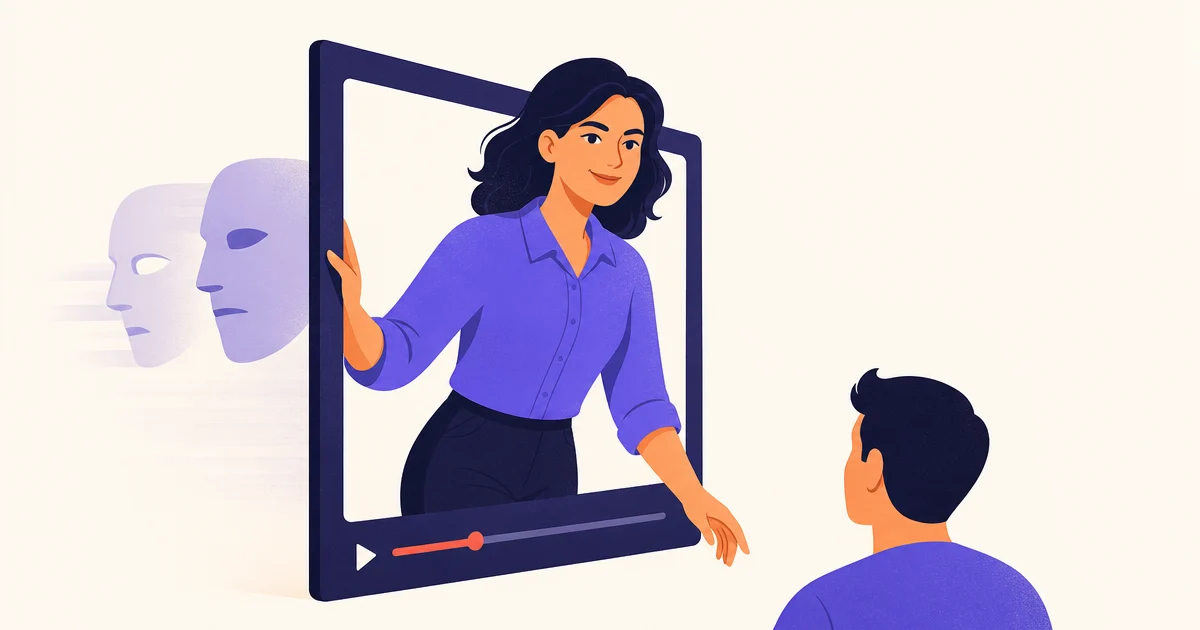
Deepfakes flipped the presumption: a face on screen is no longer proof, it's a question. Customers now doubt by default, and that doubt costs everyone sales. It also creates a valuable asset, an identifiable human who puts their face, voice and answer on the line. A video funnel turns that into a system.
The day a video call cost $25 million
In January 2024, a finance employee at the engineering group Arup, in Hong Kong, joined a video conference with the company's CFO and several colleagues. He recognized the faces, the voices, the mannerisms. He was asked to execute a series of transfers; he did. Twenty-five million dollars left, and according to CNN's account, every participant on the call except him was a deepfake.
The story made the rounds of finance departments. It should make the rounds of marketing departments too, because it says something broader than fraud: the eye is no longer enough. In February 2025, iProov put 2,000 people in the UK and US through a detection test. 0.1% of them correctly identified every piece of content, real and fake. More than 60% nonetheless said they were confident in their judgment. And video fools better than stills: participants caught it 36% less often.
Two people out of two thousand. Everyone else, meaning your customers, has no reliable way to know whether the face talking to them exists.
What doubt does to commerce
When detection fails, the brain does what it knows: it generalizes the suspicion. In an Adobe survey of 2,002 Americans run in August 2024, 87% say generative AI makes it harder to tell real from fake, and 74% have doubted the authenticity of a photo or video published by a reputable news outlet. If doubt reaches newsrooms, it reaches your product page, your customer testimonial and your founder video long before.
Marketing is already paying that bill, often without seeing it. Written reviews, long the first social proof of ecommerce, have become the first suspects: in August 2024 the FTC adopted a rule that explicitly bans reviews and testimonials attributed to people who don't exist, AI-generated ones included, with civil penalties attached. When a regulator has to ban fake customers, it's because real customers no longer believe the real ones.
Professional fraud confirms the scale. In its 2025-2026 report, built on more than four million fraud attempts analyzed, Sumsub finds that deepfakes account for 11% of identity fraud schemes observed in 2025. That's no longer a theoretical risk. It's an accounting category.
Proof has changed nature
Since the image proves nothing anymore, proof migrates to what an image can't do on its own: behave. Three signals remain readable by a customer with no detection tool, and they're the same ones an investigator uses.
Consistency, first. The same face on the homepage, in the videos, on social, in customer service, over years. A deepfake lives in a clip; a person lives in a trajectory. Specificity, next: a fake testimonial talks to everyone, a human talks to someone. A video that picks up your exact situation, your words, the problem you just described carries a signature generic content doesn't have. And commitment, finally: the possibility of replying, asking a question, booking a call, paying and being delivered by someone who stands behind it. The fake flees verification. The real invites it.
That's what consumers ask for when asked directly. In the same Adobe survey, 93% want to know how the content they consume was made, and 78% say that transparency would strengthen their trust. They aren't asking for fewer images. They're asking for an origin.
The video funnel as proof of life
A video funnel checks all three signals by construction, which wasn't its original purpose but has become its most contemporary argument. The quiz collects the prospect's situation, then their answers assemble a personalized analysis video of 10 to 15 minutes, edited from segments actually filmed by the founder or the seller, and delivered about two hours later. No avatar, no voice synthesis, no generated imagery: the person who sells, on camera, answering what you just said.
Watch the three signals line up. Consistency: it's the same face as on the landing page, the socials and the follow-ups, filmed once, found everywhere. Specificity: the video picks up your answers, your goal, your sticking point, which no generic content can imitate without having listened to you. Commitment: it ends on an open door, payment or booking, with someone identifiable behind it. The levers that then drive the purchase, reciprocity for ten minutes given, conviction for a full argument watched, are the ones our piece on persuasion principles in marketing lays out. They only work if the recipient believes in the person. Generalized doubt makes that point decisive.
Accounts running this model measure it. BodyTime, a fitness program company, holds 13 minutes of attention per prospect before its offer even appears, with conversion multiplied by 2.5 on the same traffic. Anna Velazia, a jewelry and lithotherapy brand, made her video funnel her top acquisition channel, with 70% of her ad budget and 3x the ROAS of her other campaigns. Those figures belong to those two accounts. They say what a real face earns when the rest of the web can no longer vouch for a single one.
"A deepfake could personalize too"
The objection is right on the technology and wrong on the economics. Yes, a fake face can be generated saying your first name. But proof of humanity isn't in the clip, it's in what surrounds it: the same person reachable after the video, the delivery that arrives, the review that stays up for ten years, the founder you meet at a trade show. A fake can imitate a video. It can't sustain a relationship, and the relationship is what the customer buys when they pay for an offer where advice matters.
There's also the matter of price. The brand that cheats no longer cheats for free: the FTC rule now exposes it to civil penalties, and a single exposure destroys what honesty takes years to build. Filming your segments for real, by contrast, costs two to four hours and a recent smartphone. In a market where fake has become cheap and real has become verifiable, honesty is no longer only a virtue. It's the cheapest strategy.
Show who's selling
For twenty years, ecommerce worked at erasing the seller: no face, no voice, a catalog and a button. Deepfakes just made that erasure dangerous, because a site with no identifiable human now looks like every site people are learning to avoid. The reverse movement is under way, and it's measurable in personalized video for ecommerce: the categories where a purchase commits the buyer, and where the customer needs to know who they're talking to.
Proof of humanity isn't declared, it's shown. A constant face, an answer to what the customer said, an open door to verify. All of it fits in a video you actually had to film. On a web where two people in two thousand can still tell real from fake, it may be the only thing about you a customer can still believe.
Frequently asked questions
Can you spot a deepfake with the naked eye?
Not reliably. Of 2,000 people iProov tested in 2025, 0.1% correctly identified every real and fake item, while more than 60% said they were confident in their judgment. Synthetic video is caught 36% less often than a synthetic image. Proof has to come from elsewhere: consistency over time, specificity of the message, and the ability to verify.
Do deepfakes change how people trust brands?
Yes, by contagion of doubt. In Adobe's August 2024 survey of 2,002 Americans, 87% say generative AI makes it harder to tell real from fake and 74% have doubted photos or videos published by reputable outlets. The suspicion spreads to reviews, testimonials and brand videos, which is what makes an identifiable human newly valuable.
Are AI-generated fake testimonials illegal?
In the United States, yes: the FTC's final rule announced on August 14, 2024 bans reviews and testimonials attributed to people who don't exist or who never used the product, AI-generated ones included, and opens the door to civil penalties. A real, filmed testimonial from an identifiable customer or founder becomes the safe path.
How do you prove there's a human behind an online brand?
Through three signals no image supplies on its own: consistency (the same face on the site, in videos, on social and in customer service), specificity (an answer to the customer's exact situation) and commitment (a person reachable after the video). A video funnel brings them together: segments actually filmed, a personalized analysis video built from quiz answers, then a booking or a payment.