RevenueHunt for catalog depth, Octane AI for larger brands, Lantern and VQB to start free, Quiz Kit for polish, Prehook to have your quiz built for you. And VideoFunnel when the recommendation has to be defended, not merely displayed. Here are all seven, with ratings and pricing pulled from the Shopify App Store on September 10, 2026.
The criterion no comparison measures
Open three Shopify quiz app comparisons and you'll find the same grid three times. AfterSell's reference roundup lists its six axes plainly: interface, data capture, integrations, price, user reviews, customer support. All of it can be judged before installing, in ten minutes, without having sold anything. None of it is about revenue.
One figure is enough to move the grid. Across 45 million responses collected in more than 20,000 stores, RevenueHunt's 2026 benchmark measures that 67% of quiz-attributed orders arrive the same day, and 88% within seven days. Flip the first number over: close to a third of the orders a quiz produces are decided after the visitor closed the tab.
That's the real criterion, and it fits in one question. What becomes of the recommendation once it appears? For the two thirds who buy immediately, it has to convince on screen. For the remaining third, it has to keep working for days, off the site. An app that displays three products and fires a reminder email does half the job on the first group, and almost none on the second.
What the format pays when it's handled well, the same study measures: 69% of visitors who start a recommendation quiz finish it, 5.5% of finishers place an order, roughly 2.75x the average store rate. Their carts also run 11 to 15% above normal. The raw material is excellent. The question is who does something with it.
All seven, in one table
Ratings, review counts and pricing come from the official Shopify App Store listings on September 10, 2026. The last column is the one that counts: what the tool does with the recommendation once it's on screen.
| App | Rating (reviews) | Entry price | After the recommendation |
|---|---|---|---|
| RevenueHunt Product Quiz Maker | 4.9 (453) | free up to 100 responses/mo, then $39 | results page, push to Klaviyo and Omnisend |
| Octane AI: Advanced Quiz Maker | 4.8 (207) | $50/mo, 14-day trial | results page, Klaviyo sync, Postscript and Attentive SMS |
| Lantern Product Quiz Builder | 4.9 (127) | free up to 50 quiz takers, then $39 | results page, A/B testing, 30+ integrations |
| Quiz Kit: Product Quiz Maker | 4.8 (178) | $59/mo, 10-day trial | AI-generated results page, straight to cart |
| VQB: AI Product Quiz Builder | 5.0 (89) | free up to 50 sessions, then $30 | results page, recommendation emails from $50 |
| Prehook | 4.5 (54) | free up to 10 engagements, then $45 | results page, quiz built and installed for you |
| VideoFunnel | not on the App Store, native Shopify integration | €197/mo | 10-to-15-minute personalized analysis video, actually filmed |
Read down the columns and this grid settles almost nothing: six apps between 4.5 and 5 out of 5, six entry prices inside a narrow band. It's the last column that splits them, and it splits them into two camps. Six rows display a recommendation and push it into an email tool. A seventh defends it on video.
The two heavyweights
RevenueHunt is the most installed and best rated of the group: 4.9 across 453 reviews. Its free plan takes 100 monthly responses, enough to test a quiz on real traffic before paying $39; tiers then climb to $99 and $199 for 1,000 and 2,500 responses. Its strength is the depth of the recommendation engine, its ability to map answers onto a wide catalog, and a review base thick enough for the rating to mean something.
Octane AI aims higher up market, with 4.8 across 207 reviews and a $50 monthly entry. Its listing claims more than 3,500 brands, its connections cover Klaviyo for email and both Postscript and Attentive for SMS, and the $200 tier opens A/B testing and custom CSS. It's the tool for teams that already have a retention lead and want to plug a quiz into an existing machine.
Both do exactly what they were built for: ask the right questions and name the right product. Their exit, though, is identical. A results page shows the selection, an email fires into Klaviyo, and the shopper is left alone with a product page they didn't choose. The averages on that email rebound are documented: 1.69% clicks for a campaign, 5.58% for an automated flow, across 183,000 brands analyzed by Klaviyo in 2026. For the two thirds who buy the same day, that can pass. For the other third, the conversation stops at the exact moment it should begin.
The four challengers
Lantern, from App Attic, posts 4.9 across 127 reviews and carries the Built for Shopify badge. Its free plan runs to 50 quiz takers with every feature unlocked, A/B testing included, which is rare. Beyond that, billing follows usage from $39 to $399, then $499 unlimited. For a store that wants to try this seriously without committing budget, it's the most generous entry on the market.
Quiz Kit, from Presidio, reaches 4.8 across 178 reviews on a single $59 monthly plan, everything included, with a ten-day trial. Its listing pushes migration from Octane AI, Typeform or RevenueHunt, which says plenty about this market: stores swap quiz apps the way they swap themes. VQB, rated 5.0 across 89 reviews, plays the price card at $30 entry with recommendation emails from $50. Prehook, 4.5 across 54 reviews, mostly sells a service: the vendor builds and installs the quiz for you, from $45.
Credit all four without reservation on their own ground. They're affordable, fast to install, honestly rated, and a merchant who has never asked their visitors a question will gain more by installing any one of them than by doing nothing. Their limit is the format's, not the vendor's: a results page is still a page, and a page doesn't plead.
When the recommendation has to be defended
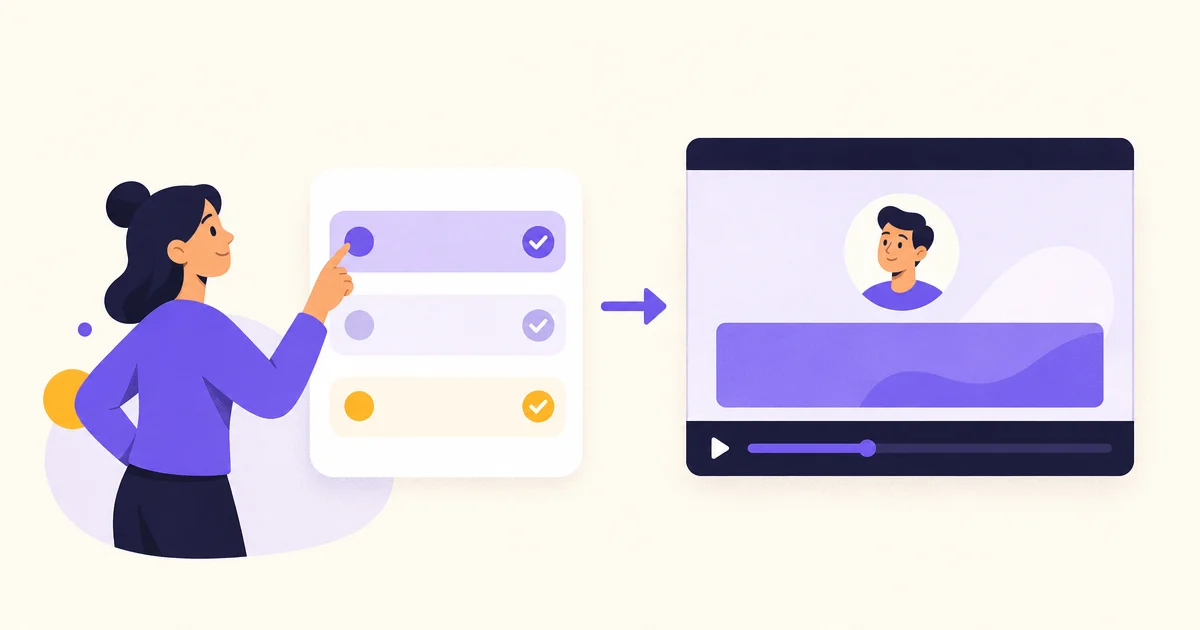
This is where a video funnel changes the nature of the exercise. The quiz serves the same diagnostic function, with 5 to 15 questions asked on camera by the seller. But its answers no longer produce a grid of products: they drive the assembly of a personalized analysis video of 10 to 15 minutes, edited from segments the brand actually filmed and delivered about two hours later. The customer doesn't just learn which product suits them. They hear why, from a person.
Look at what that difference does to the two groups from earlier. For the shopper buying today, the argument arrives at the moment of decision instead of before it. For the third who leave to think it over, the video keeps existing in their inbox, watchable that evening, shareable with a partner, and it carries a face rather than a list of SKUs. That's precisely the window where standard comparisons have nothing to offer.
Stores running it give the scale. Anna Velazia, a jewelry and lithotherapy brand whose catalog is chosen largely on intuition, moved 70% of her ad budget to her video funnel, now her top acquisition channel with 3x the ROAS of her other campaigns. BodyTime, a fitness program company, multiplied conversion by 2.5 on the same traffic, holding 13 minutes of attention before its offer even appeared. Those numbers belong to those two accounts; the full journey is laid out in our piece on personalized video for ecommerce.
One point of honesty: VideoFunnel doesn't install from the Shopify App Store. It connects to the store through its native Shopify integration, and asks for two to four hours of filming up front, a recent smartphone being enough. That's the investment that creates the gap: any competitor can install a quiz app in an afternoon, and very few will ever film the segments that turn that quiz into an advisor.
Choosing in three questions
Is your product chosen or compared? If the shopper already knows what they want and is hunting the right SKU, a standard quiz app does the sorting job, and the first six rows of the table are roughly interchangeable. If the choice requires advice, a video that argues beats a page that lists, and the video funnel for ecommerce covers where the gap widens most.
How many of your orders land the same day? Pull that number from your own store rather than the 67% average. The longer your decision window, the larger the share of revenue decided off the site, and the worse a results page works as a last word.
Finally, who will talk to the customer? None of the six apps compared here claims to, and rightly so, it isn't their job: they sort, filter, recommend. The day you want someone to defend the recommendation, no builder setting will hand it to you. You'll have to film for half a day. The table above tells you what the first six rows cost; the seventh tells you what the only one that speaks costs.
Frequently asked questions
What is the best quiz app for Shopify?
It depends on what the quiz has to produce. RevenueHunt (4.9 across 453 reviews) has the strongest review base and a free 100-response plan; Octane AI targets larger brands; Lantern and VQB let you start without paying. If the recommendation needs to be argued rather than merely displayed, VideoFunnel is the only one of the seven that follows it with a personalized analysis video.
Is there a free Shopify quiz app?
Yes, several. RevenueHunt takes 100 responses a month free, Lantern 50 quiz takers with every feature unlocked, VQB 50 sessions, Prehook 10 engagements. Those tiers are enough to validate a question flow on real traffic, not to run an acquisition channel: the quotas fill within days once a store gets volume.
Do quizzes actually increase Shopify sales?
The format's data is solid: 69% of visitors who start a recommendation quiz finish it, 5.5% of finishers place an order, roughly 2.75x the average store rate, and their carts run 11 to 15% above normal (RevenueHunt, 2026, 45 million responses). What you gain beyond that depends on what becomes of the recommendation once it's displayed.
How much does a Shopify quiz app cost?
Paid entry prices checked on September 10, 2026 run from $30 a month for VQB to $59 for Quiz Kit, with $39 for RevenueHunt and Lantern, $45 for Prehook and $50 for Octane AI. Higher tiers, indexed on monthly response volume, climb to $199, $499 and beyond for large stores.